
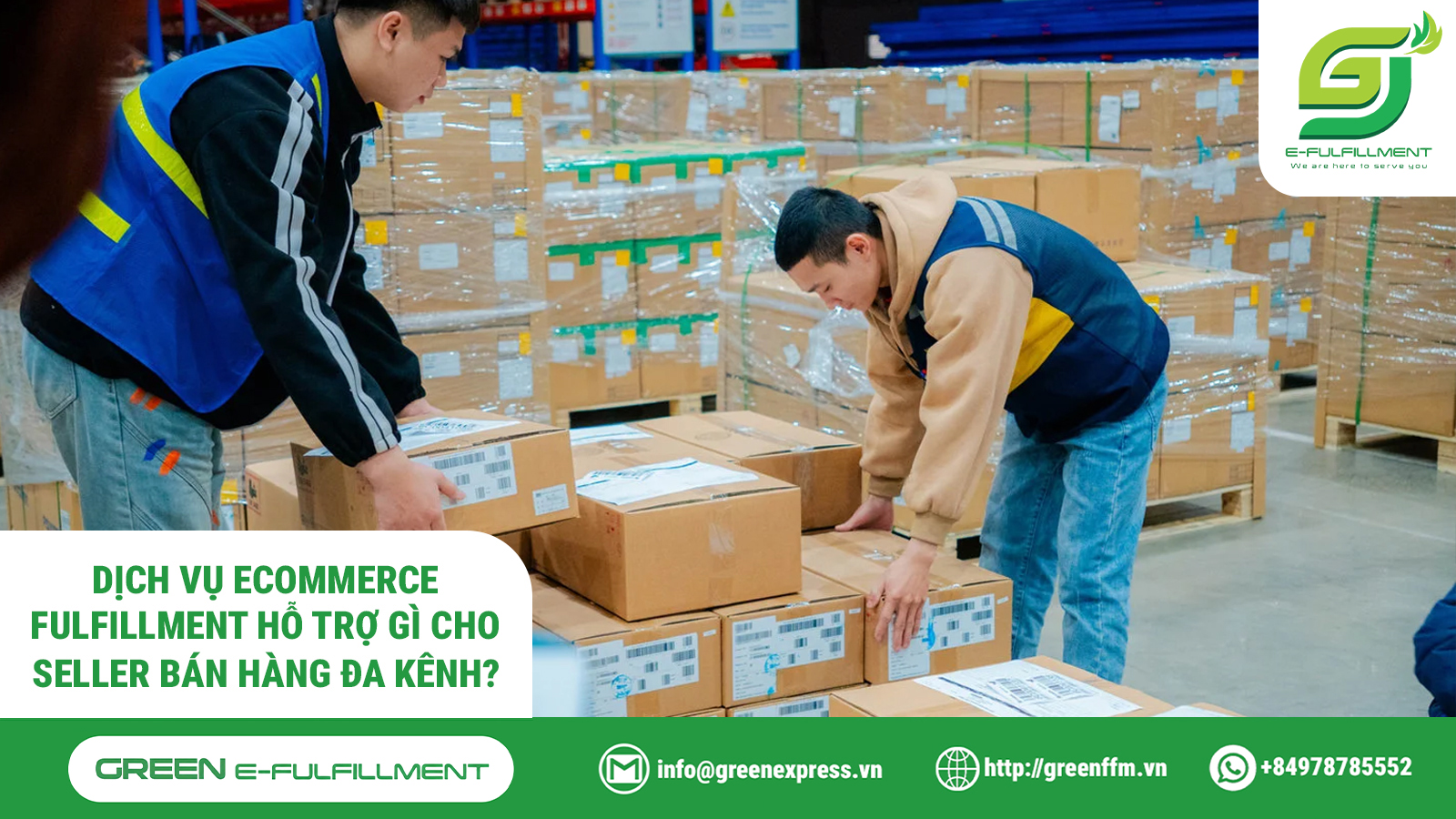
Omnichannel Selling Challenges and How Ecommerce Fulfillment Solves Them
Omnichannel selling often gives sellers headaches — from inaccurate inventory, overlapping orders, to late SLA deliveries. Ecommerce Fulfillment services solve these issues through advanced technology and professional operational processes.
1. Centralize All Orders from Multiple Channels on One System
When selling across multiple platforms such as Shopee, Lazada, TikTok Shop, your website, or physical stores, sellers often struggle with fragmented order management. Ecommerce Fulfillment addresses this issue with an Order Management System (OMS) that connects directly to all sales channels, automatically collecting and consolidating orders into a single unified platform.
How does Ecommerce Fulfillment support omnichannel sellers?
This integration allows sellers to manage and track all orders in one place — no need to manually check each channel. The system automatically syncs order statuses in real time, helping to:
-
Reduce the risk of missed or delayed orders.
-
Speed up processing time.
-
Save on labor costs for multi-channel management.
2. Real-Time, Accurate Inventory Management
Omnichannel sellers often face mismatched inventory data — for example, Shopee showing 10 units in stock while Lazada shows 1,000. When managed manually, each platform calculates stock separately, causing fast-moving channels to run out of stock while slower ones are overstocked.
Ecommerce Fulfillment eliminates this issue with a Warehouse Management System (WMS) that syncs directly with the OMS. Every transaction — inbound, outbound, or return — is automatically updated in real time across all channels.
So instead of each platform showing different quantities, your total stock appears as one unified figure (e.g., 1,010 units).
This ensures:
-
Accurate, transparent inventory data at all times.
-
No “out-of-stock on one channel, oversupply on another” situations.
-
Proactive stock management, allowing sellers to restock or clear items efficiently and seize every sales opportunity without stock errors.
👉 Read more: Key considerations for sellers when implementing Ecommerce Fulfillment
3. Fast, Accurate Order Processing Across Channels
In multi-channel selling, order processing errors are common — wrong SKUs, incorrect quantities, mismatched promotions, or non-standard packaging per platform.
For instance, the same product might come with a free sample on Shopee but not on your website. Without clear rules, staff can easily make mistakes, leading to wasted time and poor customer experience.
Ecommerce Fulfillment standardizes the entire order fulfillment process, regardless of the sales channel. Through the OMS, every order displays details such as product code, quantity, special requests (vouchers, freebies, etc.), and packaging requirements. Products are barcode-managed, ensuring 99.9% picking and packing accuracy.
Benefits include:
-
Orders from all channels are processed quickly and correctly, meeting each platform’s unique standards.
-
High accuracy even during peak sales seasons.
-
Branded packaging options (custom boxes, logo prints, thank-you cards, vouchers, etc.) deliver a consistent brand experience across all channels.
4. On-Time Delivery, Meeting All Platform SLAs
Each sales platform has different SLA (Service Level Agreement) policies and preferred shipping partners. Without automation, sellers risk missing deadlines, facing penalties, and disappointing customers.
Ecommerce Fulfillment connects via API to major logistics providers (SPX, Lex, GHN, GHTK, etc.), automatically syncing each platform’s SLA data. Orders are prioritized based on urgency — for instance, express 2-hour or 4-hour orders are highlighted for immediate handling.
The system also alerts operators when orders are close to exceeding SLA limits, minimizing risks of delay penalties. Non-urgent orders are processed afterward for better resource allocation.
As a result:
-
Sellers achieve 99% on-time SLA delivery rate.
-
Avoid penalties and maintain high shop ratings.
-
Ensure customer satisfaction with consistent, timely delivery.
5. Streamlined Returns and Post-Sales Management
Manual return handling across multiple platforms often leads to confusion — one channel marks an order as returned while another hasn’t updated yet. This creates discrepancies in inventory, inaccurate reports, and difficulties reconciling COD payments.
Ecommerce Fulfillment centralizes and automates this process. All return data from every channel is synced to the OMS for unified handling. Each returned item is inspected — good-condition items are restocked, defective ones are categorized separately.
All return statuses and inventory data are updated in real time across channels. The system also supports transparent multi-channel COD reconciliation, allowing sellers to export detailed or consolidated reports for better financial control.
With Ecommerce Fulfillment centers in Ho Chi Minh City and Hanoi, supported by modern OMS & WMS technology and professional operations, N&H Fulfillment is a trusted partner for omnichannel sellers.
Especially, sellers partnering with N&H Fulfillment enjoy free access to the OMS system — allowing them to focus entirely on boosting sales, while N&H Fulfillment handles every complex logistics and fulfillment task.
Would you like me to make this version more natural and persuasive for international marketing (e.g., website or brochure tone) — instead of just a direct translation? I can refine it into polished business English for professional publication.
 EN
EN  VI
VI